



A treasure trove of cultural identity
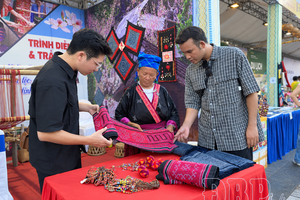
Điện Biên boasts a variety of traditional crafts, each deeply rooted in the cultural identity of its ethnic communities. To date, the provincial People’s Committee has officially recognized 12 traditional crafts, one craft village, and one traditional craft village.
Several of these crafts have been honored as part of Vietnam’s national intangible cultural heritage. These include: the embroidery shoe-making craft of the Hoa people (Xạ Phang); the art of creating patterns on traditional costumes of the Flower Hmong; the craft of making and playing the khèn (bamboo mouth organ) by the Hmong; traditional snack-making by the white Thai of Mường Lay (such as khẩu xén and chí chọp cakes); the traditional costume-making of the Hà Nhì; the blacksmithing of the Hmong; and textile ornamentation by the Lao community.
In late 2024, four traditional crafts in Tủa Chùa district were officially recognized, including the khèn crafting in Súng Ún hamlet, Mường Báng commune. Notably, in January 2022, “Folk knowledge and the art of performing the Hmong khèn in Điện Biên” was inscribed on the national list of intangible cultural heritage. The khèn craft is deeply woven into the everyday life and cultural identity of the Hmong.
.jpg)
Thào A Lử, head of Súng Ún hamlet, shared: “Khèn making is a traditional craft passed down through generations, deeply tied to Hmong culture. Currently, only two artisans in our hamlet continue this work. Yet, the khèn remains an essential musical instrument in our cultural and ceremonial events, especially weddings and funerals, making it vital to preserve and pass on.”
Creating a khèn is a meticulous process, requiring both dexterity and patience. Artisan Chang A Vàng of Súng Ún explained: “A Hmong khèn consists of three parts. The main body is carved from fokienia wood into a pre-defined shape, with holes drilled into the center and sides. The pipes are made of bamboo, one large pipe and five smaller ones of varying lengths. The reeds are carefully cut from red copper to match the tone of each pipe. All parts are then assembled. It may sound simple, but crafting a single khèn demands considerable time and effort.”
Like khèn-making, every traditional craft demands heartfelt commitment, pride, and love for one’s heritage. Each product is a reflection of communal identity and creativity, highlighting the craftsmanship and artistic sensibilities of Điện Biên’s ethnic groups and adding color to the province’s cultural mosaic.
Preserving and passing down the heritage
To safeguard this “cultural treasure,” local authorities are taking concrete steps to ensure continuity. In 2024, under Vietnam’s national target program for socio-economic development in ethnic minority and mountainous areas, Tủa Chùa district organized several vocational training classes. Among them were workshops for three crafts still undergoing official recognition: Hmong khèn-making, Hmong blacksmithing, and embroidered shoe-making by the Hoa. However, participation among younger generations remains limited, and few trainees continue to practice the crafts after the courses end.
This challenge is echoed across other traditional crafts, such as the Thai bamboo and rattan weaving in Nà Tấu 1 hamlet, Nà Tấu commune, Điện Biên Phủ city. One of the first officially recognized crafts in the province, this weaving tradition was recently included in the national list of intangible cultural heritage. While this recognition should have spurred local pride and renewed interest, reality paints a more somber picture.
Lò Văn Cương, former director of the Nà Tấu bamboo and rattan weaving cooperative, shared: “Our cooperative disbanded in May. We faced numerous challenges in sustaining the craft such as lack of a stable market, limited investment, dwindling raw materials, and aging artisans. The youth today show little interest in these traditions. Most skilled weavers here are elderly. Now that it’s a recognized cultural heritage, we can only hope this brings new opportunities for the craft’s revival.”
Bamboo and rattan weaving is an age-old tradition passed down through generations of Thai people. The products are diverse, spanning religious items, household tools, and farming implements. While some Thai communities across the province still maintain the practice, the Nà Tấu cooperative was once a model for preserving and commercializing traditional crafts, with ambitions to integrate them into tourism and offer sustainable livelihoods.
The closure of the cooperative highlights the broader difficulties of sustaining traditional crafts in today’s modern society. To truly preserve these cultural gems and enable artisans to make a living from them, stronger community engagement is essential, alongside targeted support, strategic planning, and investment from local authorities and cultural institutions.
Nguyễn Hiền
.jpg)
.jpg)
.jpg)
.jpg)

.jpg)
.jpg)
.jpg)


.jpg)
.jpg)
.jpg)
You have 500/500 characters left
Please enter 5 or more characters!!!